Total Carbs or Net Carbs: What Really Counts?
 Martina Slajerova
This post may contain affiliate links, see our disclaimer.
Disclaimer: You should consult any dietary changes with a health professional, especially if you have a health condition such as diabetes or heart disease. You may need an adjustment to the medication you are taking.
Critical thinking is key to separating facts from personal opinions and unproven theories. With the ever increasing amount of misinformation, it's easy for people to get confused and fall for diet or lifestyle dogma. My advice is to always do your own research and learn what works best for you - no diet plan fits all and you always need to make small adjustments to fit your needs.
Here are a couple of examples that are frequently discussed within the low-carb community:
- One of the myths is that if you follow a low-carb diet, you can eat unlimited calories, while losing weight and staying healthy. Although it's not common to overeat due to natural appetite control of low-carb diets, this belief results in overconsumption which is never beneficial no matter which diet you follow.
- A great example of a post questioning the effects of high cholesterol and saturated fat intake can be found at Low Carb Dietitian. About 25% of people following a low carb diet experience very high cholesterol levels. There is increasing evidence that cholesterol and saturated fat do not cause heart disease. Does this mean that very high cholesterol levels are completely safe and even desirable? Not necessarily - even if your C-reactive protein test shows that your inflammation is low, it doesn't mean that it's safe to have very high cholesterol levels. Keep in mind that low-carb diets are not just about eating foods rich in saturated fat found in butter or fatty meat. In addition to saturated fats, many experts, including Dr. Jeff Volek, emphasise the importance of heart-healthy MUFA and omega-3 fatty acids.
Defining Total Carbs, Net Carbs, Soluble & Insoluble Fibre
Should total carbs be considered when following a low-carb, ketogenic diet? Does eating fewer carbs always lead to better weight loss and improved health? Although most people still count net carbs (total carbs without fibre), the new trend within the low-carb community seems to be towards counting total carbs. Typically, people that count total carbs follow a very low-carb diet consuming 20 grams of total carbs or less a day. So, what is the right way to count carbs?
The main reason for this post was that many of my readers are convinced that counting total carbs and following a very low-carb diet is the ONLY way to go. Finding relevant information wasn't easy, as the effects of fibre on blood sugar and metabolic health are still a subject of research.
In short, net carbs are total carbs without fibre. There are two types of fibre: soluble and insoluble. The reason why most people use net carbs (aka available carbohydrates) is because they believe that dietary fibre doesn't affect blood sugar and our body cannot derive any calories from it. However, this claim isn't entirely accurate because it only applies to insoluble fibre which cannot be absorbed and has no effect on blood sugar and ketosis.
Dietary fiber is the indigestible portion of plant foods and has two main components: insoluble fiber (principally cellulose and lignin) and soluble fiber such as galacto-oligosaccharides and fructooligosaccharides (FOS), which are fermented by the gut microbiota into the short-chain fatty acids (SCFAs) acetate, propionate, and butyrate. (Flint et al. 2012Trusted sourceNational Center for Biotechnology InformationNCBI's mission is to develop new information technologies to aid in the understanding of fundamental molecular and genetic processes that control health and disease.Open link)
Overview of Fibre in a Few Common Keto-friendly Foods:
| Foods (serving size) | Total fibre per serving | Soluble fibre (g) | Insoluble fibre (g) | Percentage of soluble fibre |
| Avocados, medium | 10.1 | 4 | 6.1 | 40 % |
| Almonds, 1 oz (28 g) | 3.5 | 0.4 | 3.1 | 10 % |
| Beans, green, 1 cup | 3.7 | 1.6 | 2.1 | 16 % |
| Beet greens, 1 cup | 1.4 | 0.4 | 1 | 28 % |
| Blackberries, 1 cup | 7.6 | 1.4 | 6.2 | 18 % |
| Broccoli, 1 cup | 2.6 | 0.9 | 1.7 | 35 % |
| Brussels sprouts, 1 cup | 6.4 | 3.9 | 2.5 | 60 % |
| Cabbage, green, 1 cup | 2 | 0.7 | 1.3 | 35 % |
| Cauliflower, 1 cup | 2.5 | 0.9 | 1.6 | 36 % |
| Celery, 1 cup | 2 | 0.7 | 1.3 | 35 % |
| Chard, 1 cup | 3.7 | 0.6 | 3.1 | 16 % |
| Chia seeds, 1 tbsp | 4.5 | 1.1 | 3.4 | 25 % |
| Collards, 1 cup | 1.3 | 0.8 | 0.5 | 61 % |
| Dark chocolate, 1 oz | 1.7 | 0.1 | 1.6 | 6 % |
| Flax seed, 1 oz (28 g) | 7.7 | 4.2 | 3.5 | 54 % |
| Jicama, 1 cup | 6.4 | 3.3 | 3.1 | 52 % |
| Kohlrabi, 1 cup | 4.9 | 3.4 | 1.5 | 70 % |
| Lettuce, 1 cup | 0.9 | 0.3 | 0.6 | 33 % |
| Macadamia nuts, 1 oz (28 g) | 2.4 | 0.5 | 1.9 | 20 % |
| Pepper, green, 1 cup | 2.7 | 1.1 | 1.6 | 40 % |
| Psyllium husk powder, 1 tbsp | 5.8 | 1.7 | 4.1 | 30 % |
| Pumpkin, 1 cup | 7.1 | 1 | 6.1 | 14 % |
| Radish, 1 cup | 1.9 | 0.5 | 1.4 | 5 % |
| Raspberries, 1 cup | 8.4 | 0.9 | 7.5 | 11 % |
| Rhubarb, 1 cup | 4.8 | 1.2 | 3.6 | 25 % |
| Sauerkraut, 1 cup | 5.9 | 2 | 3.9 | 33 % |
| Spinach, 1 cup | 0.8 | 0.2 | 0.6 | 25 % |
| Summer squash (zucchini), 1 cup | 1.4 | 0.6 | 0.8 | 42 % |
| Strawberries, 1 cup | 3.3 | 0.9 | 2.4 | 27 % |
| Tomatoes, 1 cup | 2 | 0.2 | 1.8 | 10 % |
| Turnip, 1 cup | 3.1 | 1.1 | 2 | 35 % |
The Role of Soluble Fibre
Researchers have estabilished that our bodies can derive calories from soluble fibre.Trusted sourceNational Center for Biotechnology InformationNCBI's mission is to develop new information technologies to aid in the understanding of fundamental molecular and genetic processes that control health and disease.Open link However, when it comes to the effects of soluble fibre on blood glucose, it's more complicated. Studies show that soluble fibre can be absorbed and used for intestinal gluconeogenesis (IGN) which was thought to increase blood sugar and therefore affect ketosis. This potential ability of soluble fibre to affect blood sugar and therefore ketosis is the main reason why some experts and bloggers recommend using total carbs rather than net carbs.
How does it work? The short-chain fatty acids (SCFAs) propionate and butyrate, which are produced by fermentation of soluble fibre in the colon, activate IGN. While butyrate plays a role in enhancing energy expenditure, propionate enhances hepatic gluconeogenesis (release of glucose from the liver).
However, a recent study shows that soluble fibre helps, in fact, lower blood glucose. According to this this study, propionate can be used by the body for IGN and the overall effect of SCFAs through IGN is a net decrease in blood sugar. Unlike hepatic gluconeogenesis, IGN helps lower serum concentrations of glucose and improves overall glucose disposal. Commonly, increased production of SCFA is assumed to be beneficial by reducing hepatic glucose output and improving lipid homeostasis. (Weickert et al. 2008)
Additionally, when soluble fibre is fermented in the large intestine, it stimulates the release of gut hormones which play a role in inducing satiety (Lattimer et al. 2010Trusted sourceNational Center for Biotechnology InformationNCBI's mission is to develop new information technologies to aid in the understanding of fundamental molecular and genetic processes that control health and disease.Open link). As most of you may know, natural appetite suppression is the main reason people successfully lose weight on a low-carb diet.
Update: You can learn more about the role of soluble fibre in this post: Nuts & Seeds on a Ketogenic Diet
Bottom Line: Does soluble fibre raise blood sugar? Recent studies show that soluble fibre can, in fact, lower blood glucose levels. However, more studies are needed to understand the effects of dietary fibre on metabolic health.
Total Carbs vs Net Carbs. Ask Yourself: What Am I Trying to Achieve?
Should you count total or net carbs? It depends on what your goal is and how sensitive to carbs you are. Some people may be affected by the tiniest amount of carbs from berries while others can eat most foods without any issues.
I personally prefer using net carbs which is also reflected on my blog and in my apps. My main goal is to maintain my weight and manage my thyroid condition which I've been dealing with since 2011. You can read more about my diet here. When we created the KetoDiet iPad app, we focused on net carbs but also allow our users to check their total carbs count (see below).

In general, if you follow a low-carb / ketogenic diet to lose weight and improve your health, counting net carbs is a convenient way. In fact, high level of ketones / low level of glucose are not the most important factors in weight loss. Research simply doesn't support the idea that more ketones in your blood always lead to a greater fat loss. The most important factor in successful weight loss on a low-carb diet remains its appetite-suppressing effect.
In fact, you don't necessarily need to be in ketosis to lose weight or improve your overall health - there are other important factors to consider when your weight is stalling. Many studies that show improvements in both weight and health were performed on people eating even more than 50 g of total carbs a day. This review and meta-analysis of clinical trials shows thatTrusted sourceNational Center for Biotechnology InformationNCBI's mission is to develop new information technologies to aid in the understanding of fundamental molecular and genetic processes that control health and disease.Open link not all of the studies were strictly focused on very low-carb, ketogenic diets throughout the whole trial.
Here are the most common reasons people follow a low-carb diet:
- weight loss (fat loss)
- improve overall health
- improve performance / increase lean mass
- manage a disease such as cancer, Alzheimer's, epilepsy or PCOS
Weight loss & health effects
Following a low-carb diet leads to weight loss in most cases but more ketones don't seem to adequately enhance weight loss. Accordingly, you don't need to follow a very low-carb diet (VLC) if your aim is to improve your health. Many people experience great benefits following the paleo diet with low-moderate carbohydrates.
Exercise & performance
The effects of the ketogenic diet on performance are described in Volek & Phinney's book devoted to low-carbohydrate performance. It's also worth checking Dr Peter Attia's website, Eating Academy. Your carb requirements and timing of carbs depend on the type of exercise. The general consensus is that if you mostly do weight training and cardio exercise, you can fully function on ketones and don't need any extra carbs. If, however, you do a lot of HIIT or Cross Fit, you may benefit from carb backloading, as the standard ketogenic diet may not be best for you.
Cancer management
Some people may follow a more restricted type of the ketogenic diet for therapeutic purposes. Ideally, the ketone level should be high while the blood sugar level should be low. Using total carbs and following a VLC diet may be a better way of counting carbs. You can find out more in our expert article on the effects of the ketogenic diet in patients with brain cancer.
What Do Experts Say?
There are differences of opinion even among experts not only whether to count total or net carbs but also regarding the "ideal" carb level. Dr Volek & Phinney suggest that ~ 50 g of total carbs a day is enough to induce nutritional ketosis. This is 20-35 grams of net carbs depending on the fibre content. Most people on a ketogenic diet successfully follow this approach.
This approach is different from Dr. Westman's approach suggesting that ~ 20 g of total carbs a day is what you should be aiming for. If you choose to follow a VLC diet, make sure you get sufficient micronutrients and include supplements, especially magnesium. You won't be able to eat avocados, some vegetables or psyllium husk powder unless you use very small amounts.
Should some healthy low-carb foods be avoided because they are high in total carbs? In fact, two thirds of the fibre in most foods is insoluble meaning it has zero effect on blood sugar and zero calories. As I mentioned above, although more studies are needed to understand the effects of dietary fibre on metabolic health, it seems that soluble fibre can, in fact, lower blood glucose levels. (Lattimer et al. 2010Trusted sourceNational Center for Biotechnology InformationNCBI's mission is to develop new information technologies to aid in the understanding of fundamental molecular and genetic processes that control health and disease.Open link)
Bottom Line: There is no "wrong" way, you can use either total carbs or net carbs. Choosing the "best" way for you depends on what you are trying to achieve by following the ketogenic diet.
Other Factors Which Play a Role in Weight Loss
Don't focus only on your carb intake. How about your protein or fat intake? It's a common misconception that you can eat an unlimited amount of calories and still lose weight. In fact, you can put on weight even on a low-carb diet. To avoid this mistake, you will need to understand a few basic principles and avoid common mistakes. Make sure you eat enough protein, not just fat - protein is the most sating macronutrient and will keep hunger at bay.
Low-carb ketogenic diets are naturally sating and act as appetite suppressants. This is why you'll eat less and won't need to count calories, which is one of the main effects of low-carb diets. In fact, to lose weight or/and stay in ketosis, you don't need to follow a VLC.
One of the common mistakes people make is that some people overeat dairy and nuts when they are trying to lose weight. You may experience weight stalling or even weight gain not because nuts and dairy will kick you out of ketosis but because these foods are calorie-dense and easy to overeat (100 grams of macadamia nuts have over 700 kcal and over 70 grams of fat!) There is no reason to avoid non-starchy vegetables such as broccoli, cauliflower, zucchini, bell peppers or fruits like avocado or berries. These foods are very high in micronutrients, low in carbs and won't impair your weight loss efforts.

If for any reason your weight is stalling for more than 2-3 weeks, you may need to consider keeping an eye on your energy intake (calories). Reaching a weight loss plateau may be caused by several factors and you don't necessarily have to be eating too much, in fact, you may discover that you haven't been eating enough. In my experience, losing body fat becomes more and more difficult as you get close to your target weight.
To make it easy for you to calculate your ideal macronutrients on a ketogenic diet, we developed a free online keto calculator, KetoDiet Buddy - try it now!
Ideally, you may also want to talk to an expert with experience in low-carb diets. My good friend, Franziska Spritzler, who is a low-carb dietitian, has great experience helping people lose weight and manage diabetes.
What to Be Careful About
1. Labels
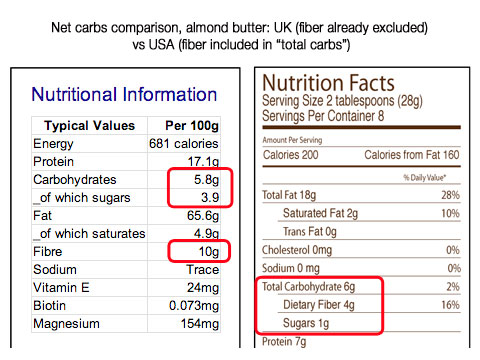
No matter which path you choose, make sure you know how carbs are calculated where you live. In countries like US or Canada, total carbs as labelled include fibre - to get net carbs, you have to deduct fibre. Contrary to the US and Canada, in countries like UK or Australia, total carbs as labelled do NOT include fibre, which means they already represent what is known as net carbs in the US.
2. Low-carb Sweeteners
The vast majority of low-carb sweeteners are often advertised as "sugar-free", "carb-free" or "zero-carb". However, this is not always true. Some sweeteners like stevia, Erythritol or monk fruit extract contain very little carbs while others like Xylitol or Tagatose contain more carbs.
When using Swerve, Erythritol, Xylitol or sweeteners containing fructooligosaccharides (FOS), always remember to add carbs. What I've noticed is that some people subtract all low-carb sweeteners and count them as "zero" - this is not right. I have explained my "safe" method of calculating carbs in sweeteners here.
3. Products labelled "Low-carb"
Avoid most products labelled low-carb / zero-carb, etc. Atkins bars, Julian's Bakery bread and Dreamfields low-carb pasta are just some of the many products to avoid. They contain more effective carbs than the manufacturer claims and are often laden with unhealthy ingredients. I have written more about low-carb products in my post here.
To read more about carbohydrates on a low-carb diet, have a look at my two posts: All You Need to Know About Carbs and How Many Carbs per Day?
You may also like

How Many Carbs per Day on a Low-Carb Ketogenic Diet?

All You Need to Know About Carbs on a Low-Carb Ketogenic Diet

Can the Ketogenic Diet Enhance Strength Performance?

Can the Ketogenic Diet Enhance Endurance Performance?

Keto-Flu and Sufficient Intake of Electrolytes

Is Aspartame Safe?
The Pyramid Just Flipped: Why the New "Real Food" Guidelines Change Everything
Keto vs. PSMF: Which Approach Promises Rapid Fat Loss?
Dirty Keto Debunked: The Pros, Cons, and Practical Tips

Is This the End of Erythritol? What This Study Means for Low-Carb Recipes

How To Balance Electrolytes When You Go Low-Carb
Why Pairing High-Protein Keto with Fasting Is the Game-Changer You Need
Beyond the Labels: A Fresh Take on Keto and 'Non-Keto' Foods

Is Erythritol Safe? Unpacking the Latest Research
The Coconut Controversy: Is Coconut Oil Really Healthy?
Sesame Seeds & Oil: Surprising Science of Sesame
Comments & ratings (124)
Great article.
What about alcohol sugar when counting carbs?
Hi Melody, this article contains information on how to count net carbs in different types of sugar alcohols: Complete Guide To Sweeteners on a Low-Carb Ketogenic Diet
Hi!
Love this website! This list showing the amounts of soluble and insoluble fiber is important to me. Is there somewhere that I could find a bigger, more comprehensive list?
Also, I noticed the listings for green beens and radishes are wrong. What are the proper amounts for those veges?
TIA, Twila
Thank you so much for noticing, I'll correct the total values. I actually used several verified food databases and studies to make this list. I haven't found anything else but I could expand on this list at some point 😊
I'm curious how resistant starch plays on insulin levels? I found pumkin seeds in the shell are a great source of fiber, 15g carbs and 5g net carbs so 10g fiber. I do count net carbs because I love avocado, portabella, sauerkraut, berries, salads, broccoli, cabbage.... The list goes on ( and on) and I personally feel fiber is very important. Thank you for such an in depth article, it was very informative!
Hi Tara, I'm just looking into resistant starch and will write a post once I have enough information. It is an interesting topic!
Question- to stay in a state of ketosis, do I always need to take in the same amount of carbs, or can it vary as long as it is under 50g?
The level of carbs that will maintain the state of ketosis varies for individuals but for most people it is under 50 grams of total carbs. Here's more about carbs:
All You Need to Know About Carbs on a Low-Carb Ketogenic Diet
How Many Carbs per Day on a Low-Carb Ketogenic Diet?
OMG, I'm American but have been living in Australia since 2011. I never knew about the labelling differences until I read your article. Now I can count carbs accurately! Thank you!
Personally, I use a third option. I have researched the amount of soluble Vs insoluble fibre across my ketogenic diet and have found that it balances out at roughly 50% of what I eat. Therefore I only like remove 50% of fibre from total carbs to get my net carbs figure. I find this is much more realistic approach and you can still get enough fibre into your diet.
Carl, thank you for your insights! That sounds like a good compromise. I found that fibre doesn't affect me at all (apart from IMOs) but it's a good great option to count it partially if you find that it does affect you.
What about Lentils and all kinds of legumes? They are high in fiber and a good way to get your fiber in. Can we consume legumes while on a ketogenic diet?
Legumes are generally too high in carbs for a keto diet. There is some info about peanuts here: Peanuts on a Ketogenic Diet: Eat or Avoid?
hello, I'm a mother of KD kid, and my son ate the KD diet for 2 years, and keep to eat for some time. I'm confuse about the fiber about the food labels. And it helps me to deal with this problem. And could you please give me some idea about how to confirm the safe of the food for the KD kid. Thank you!
Hi Kelly, just to confirm, is your son following the ketogenic diet for therapeutic purposes? What is the health issue?
Thank you for this one! It clarifies a lot!
Wow. This article is atrocious. NET carbs = WITH fiber factored in. Several times you emphasized it as “without fiber”, so it wasn’t a typo or mistake. Hard to take anyone seriously who doesn’t understand the basics.
The only atrocious thing here is your comment. You may be super confident but you are completely wrong. Just in case this makes things easier for you:
Net carbs = Total carbs minus Fibre which means that you do not count fibre when counting "net carbs". You're welcome.
You tell ‘em Martina! 💕
What about foods such as baby carrots (raw) and eggplant (steamed or baked without additional ingredients)? I've read diverging opinions on carrots and their effect on insulin production and would really love a definitive answer as they are one of my go-to snacks.
Also - is there any chance that you'll offer a program for PCs in the foreseeable future?
Thanks for any input.
In general, carrots can be included in small amounts. It also depends on individual body responses (some people will experience blood sugar spikes even with small amounts). and on your daily carb target. Eggplants are fine in moderation: Complete Keto Diet Food List: What to Eat and Avoid on a Low-Carb Diet
We do have plans to bring KetoDiet to more platforms this year and will do our best!
I used to think 'net carbs' was some kind of BullShiite accounting trick!
But, from my experience - A 40+ yo man enjoying phenomenal success on the BD 24/7 Regimen (IFF + Low Carb) I have found that certain foods which use net carbs as a selling point, are actually PREFERABLE.
My favorite example is PITA Bread. There are several out there, my preference these days is Tumaro, but there are lots of others.
At first, I wanted nothing to do with "low-carb...BREAD." I thought, what's the point. If you can't even give up bread, why are you even on this diet! haha
But, after a while of being on the BD 24/7 regimen and getting amazing results, I thought - Well, if this is my future eating practice, I WOULD like to try some bread.
Here's what I found from eating these low carb pita breads that are typically 12-14g of carbs EACH but net down to 5-6 g when fiber is deducted...
Like any carb, they are kind of addictive. Rare is the day that, when incorporating Pita, I don't eat FOUR (of the 8) slices they give you.
More typically....SIX!
But, as you indicated, it is more filling AND it gets eliminated the next day. Massively. So, it is a NET (pardon the pun) gain!!
I used low-carb Pita (Bandertio is another brand that works) once or twice a week, but may increase strategically.
Begelea
PS Stevia also has a similar effect, but to a much lesser degree. Of course, I use stevia w/BulletProof Coffee when in the fast phase!
I agree that "low-carb" foods can be addictive. I do make low-carb bread or treats using low-carb sweeteners from time to time which works great because I never feel restricted. Having said that, most of my diet is based around whole, simple foods.
Hi Martina - you write above:
"This approach is different from Dr. Westman's approach who suggests that ~ 20 g of total carbs a day is what you should be aiming for. If you choose to follow a VLC diet, make sure you get sufficient micronutrients and include supplements, especially magnesium. You won't be able to eat avocados, some vegetables or psyllium husk powder unless you use very small amounts."
My question:
What do you mean by: "..you won't be able to eat avos, some veg or psyllium husk powder" (PHP)?
I'm new to keto, but PHP seems like a God-send right now in helping me adjust and go low carb....it makes possible a lot of replacements....
And avocados are great fat + some good fiber...?
Thx! 😊
Hi Evelyn, in this example, one avocado will cover more than half of your daily carbs which doesn't leave many options for the rest of the day. Avocados are high in fibre and if you count "total" carbs and stay at a very low level, you will significantly have to limit their consumption. In my opinion, this is not the ideal way to follow the diet. Foods like avocados should be included and that can only happen if you don't count "net" carbs or if you allow for a higher total carb intake. I prefer counting "net" carbs because this approach allows me to include more nutritious high-fibre foods rather than increasing my carb intake in general. I hope this helps!
I though it was my imagination that I was less depressed and felt better on low carb. I have hashimoto's and celiac disease. I could live on Smartcakes . I am afraid of this net carb stuff.Do you still lose weight following net carbs? I was 114 lbs forever ,now 128 and cannot lose a pound. I won't leave the house. M
Hi Mary, when it comes to counting carbs, it depends where you get your them from. If it's mostly vegetables, nuts and whole foods, then it's ok to count "net" carbs as fibre from these foods will not stall your progress. The problem is that if you use "low-carb" products advertising "low net carbs", chances are:
1) they will not be displayed correctly (eg products with Maltitol and sorbitol count these sweeteners as "zero").
2) these products are often addictive and make you crave them more, especially "health" bars.
These products may be convenient but they will only stall your progress. I would personally avoid such products and opt for whole foods. I hope this helps!
I am a little confused about the ratio of carbs, protein and fat, For instance if you strive for 75% fat does that mean that 75% of your calories come from fat ?? or 75 percent of the weight of the food come from fat
Thanks so much
Hi Dean, the percentage always refer to calories so if you are aiming to get 75% fat, it is calculated from your overall energy intake in calories.
I am on a low carb low calorie diet. I want to start taking certain supplements but they contain both carbs and calories. Does the supplemental intake affect the daily allotted carb/calorie intake? I.E. daily consumption of carbs is 35 grams. The new supplements are 14 grams. Will I now only be able to consume 21 grams daily from food?
Hi Jennifer, I think that 14 grams of carbs just from supplements is too much. If I were you I'd find another supplement that is low/zero in carbs and I'd prefer to get my carbs from food together with other nutrients.
Avocado’s are high calorie too, pretty random to talk about weightloss stalling efffect of nuts and than proceed to say avocado’s are no problem.
I listed foods that are most commonly overeaten - that is the main point. We can always include all foods that are high in calories but that wouldn't help most people as it would simply be a list of high calorie foods. If you eat loads of avocados every day on top of your regular meals and they don't fill you up (very unlikely) then yes, avocados may be an issue for you too.
Hi Martina,
I am Graves and have been battling weight and inflamation for years. I have recently started following Keto and IF and feel like they are bringing me back to life. I really appreciate all you have learned to help heal yourself and I gratefully thank you for sharing.
Thank you for your kind words, Catherine!
ive been told i need about 1.2g to 0.8 g of protein per lean muscle but to much could cause me to not go in to ketosis. dew to protein converting into glycogen. so best approach at the start of my diet?
Hi Chris, there's misinformation about the ideal protein intake. The ideal protein intake varies for individuals and depends on several factors (lean mass, activity levels, etc). In fact, lack of protein will likely cause weight stalling and increased hunger. Our Keto Calculator takes all these into account. You can read more here: Ketogenic Nutrition and Exercise: Protein